Most men choose a dress shirt by collar style without ever consciously choosing it. The shirt fits, the price is right, the color works, and the collar is whatever the manufacturer decided was the default. It works, more or less. But it leaves a great deal on the table.
The collar is the detail closest to your face. Its shape, height, and spread influence how your jaw reads, how formal the shirt feels, and how the entire outfit comes together. The cuff does similar work at the wrist — quieter, but no less consequential. In a custom shirt, both decisions become deliberate rather than incidental, and the cumulative effect on how a wardrobe performs is significant.
This guide covers the primary collar and cuff styles available in custom shirting, what each one does, and how to think about choosing them for your own wardrobe.
Why Collar Style Matters
A collar does several things at once. It frames the face. It establishes the formality of the shirt. It interacts with the tie knot when one is worn. And it shapes how the shirt reads under a jacket, where the collar is one of the few visible elements of the shirt at all. The right collar suits the wearer's face shape, complements the tailoring it sits beneath, and matches the level of formality the occasion calls for.
The wrong collar is rarely catastrophic, but it's noticeable in subtle ways. A spread collar that's too wide on a narrow face can throw off the proportions. A point collar with a heavy tie knot can look crowded. A button-down collar paired with a formal suit creates a tonal mismatch even most people can't articulate.
Collar Styles Explained
There are more collar options on a custom shirt than most men realize. Here are the styles that come up most often in our consultations, and how to think about each.
The Point Collar
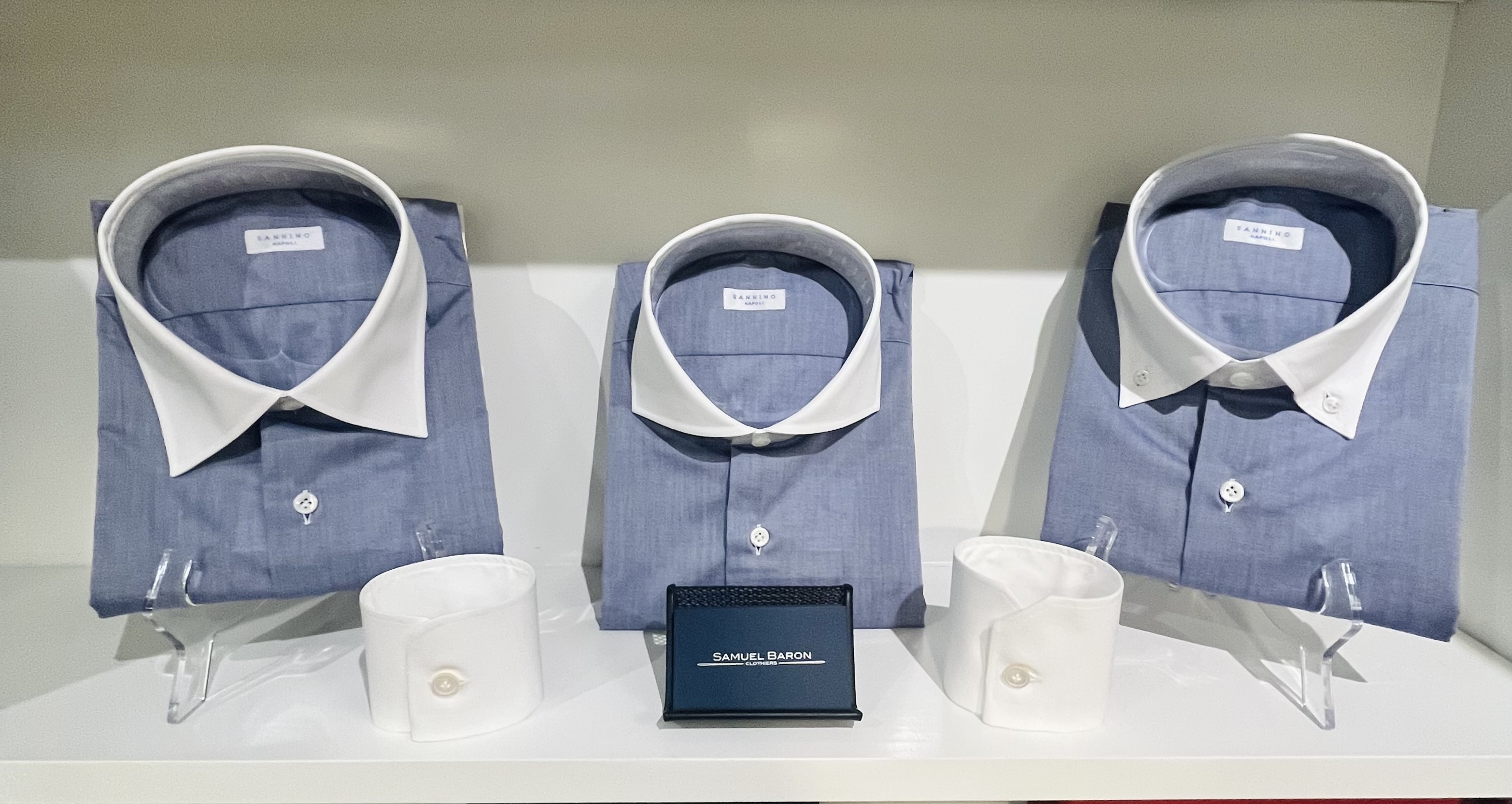
The point collar is the classic dress shirt collar. The two collar points sit close together, typically separated by one to three inches at the spread. It's the most traditional style and works particularly well with smaller tie knots — a four-in-hand or a small half-Windsor. Point collars also have a lengthening effect on the face, which makes them a good choice for clients with rounder face shapes.
In its more elongated form, sometimes called a long point collar, this style takes on a slightly more vintage character — closer to what you'd see in a 1960s photograph. It's a distinct look and worth considering for clients who appreciate that aesthetic.
The Spread Collar
The spread collar opens the collar points outward, creating more space between them. The medium spread is the most versatile collar style for modern professional dressing — it accommodates a wider range of tie knots, reads as appropriate for both business and social occasions, and balances most face shapes well.
The cutaway collar is a more pronounced version of the spread, where the collar points are angled almost horizontally. It's a stronger, more contemporary statement and pairs well with larger tie knots like the full Windsor. For clients with longer or narrower faces, the visual width of a cutaway can be particularly flattering.
The Button-Down Collar
The button-down collar has small buttons that secure each collar point to the body of the shirt. It originated in sport, specifically polo, and retains a slightly less formal character even when produced in fine fabrics. Button-down collars work beautifully with sport coats and odd jackets, and many clients who prefer a more relaxed wardrobe gravitate toward them as their everyday collar.
It's worth noting that button-down collars are generally not the right choice for very formal occasions or with the most structured business suits, where the casual association can read as slightly under-dressed.
The Tab Collar
The tab collar is one of the more distinctive options. A small fabric tab connects the two collar points beneath the tie, holding the collar firmly in place and pushing the tie knot forward. It's a polished, slightly retro look — popular in the 1960s and quietly returning in considered wardrobes today.
Tab collars require a tie. Without one, the tab itself looks awkward. For clients who almost always wear a tie and want a collar that sits cleanly at all times, the tab is a strong option.
The Club Collar
The club collar — sometimes called the rounded collar — has soft, curved collar points instead of the sharp angles of a standard dress shirt. It's an unusual choice, more common in vintage references than contemporary dressing, and reads as deliberate when chosen well. For clients building a wardrobe with personal character or who appreciate slightly older sartorial traditions, the club collar is a memorable detail.
Cuff Styles Explained
The cuff receives less attention than the collar, but it's no less important to how a shirt performs. The cuff style sets the formality of the wrist, determines whether the shirt can be worn with cuff links, and influences the small visible portion of the shirt that shows beyond a jacket sleeve.
The Barrel Cuff
The barrel cuff is the standard cuff on most dress shirts. It closes with one or two buttons and sits cleanly under a jacket sleeve. The single-button barrel cuff is the most casual; the two-button version is slightly more formal and offers a small visual refinement at the wrist.
For everyday business wear and most professional contexts, the barrel cuff is the right default. It's clean, unfussy, and works across the broadest range of occasions.
The French Cuff
The French cuff — sometimes called the double cuff — is folded back on itself and closed with cuff links rather than buttons. It's the most formal cuff style, traditionally associated with formalwear, evening wear, and the more refined end of business dressing.
French cuffs read differently in person than they do on a hanger. Under a jacket, the additional weight of the folded cuff and the small flash of the cuff link create a particular kind of presence at the wrist. For clients who appreciate that detail, French cuffs are worth incorporating into a portion of the shirt rotation. They're not the right choice for daily wear in casual workplaces, but for important meetings, formal events, and evening occasions, they elevate the shirt considerably.
The Convertible Cuff
The convertible cuff is a less common option that allows the cuff to be worn either with buttons or with cuff links. It offers flexibility, but it also lacks the definitive character of a true barrel or French cuff. Most clients who appreciate the French cuff's formality eventually move toward a dedicated French cuff shirt rather than a convertible.
How to Choose: Practical Guidance
For most clients, the right approach is to think about how the shirt will be worn before deciding on collar and cuff styles.
For everyday business wear
A medium spread collar with a barrel cuff is the most versatile combination. It works under any jacket, with any tie knot, and across the full range of professional occasions. For a client building a foundational shirt rotation, this is where to start.
For formal occasions
A semi-spread or cutaway collar with a French cuff reads as more deliberate and more elevated. For clients who attend formal events regularly, having two or three shirts in this configuration is a meaningful addition to the wardrobe.
For sport coats and odd jackets
A button-down collar with a barrel cuff reads as appropriately relaxed without crossing into casual. For clients whose wardrobes lean toward sport coats and trousers rather than full suits, button-down shirts are often the foundation.
For variety and personal character
A tab collar or club collar adds a distinctive note to a shirt rotation that already has the basics covered. These aren't first-shirt decisions — they're additions that give a wardrobe its individual stamp.
The Custom Difference
In an off-the-rack shirt, collar and cuff style are decisions made by the manufacturer based on what they expect the broadest range of customers to want. In a custom shirt, every decision is yours.
That includes the small details that don't fit neatly into the categories above. The collar height. The collar point length. The exact spread between points. The cuff width. The placement of buttons. The choice of fabric for the inside of the collar band. Each of these is a small decision, but together they produce a shirt that fits, performs, and reads exactly as intended — not approximately.
If you've been wearing dress shirts for years and have never been asked these questions, that's a reasonable starting point for thinking about a custom commission. The most rewarding shirt is rarely the one with the highest thread count — it's the one whose details were chosen for you.
If you're considering custom shirting and want to talk through the options, we'd welcome the conversation. Appointments are available at our Shadyside showroom.
Samuel Baron Clothiers is a bespoke men's clothier located at 201 South Highland Avenue in Shadyside, Pittsburgh, PA. Appointments are required. Call (412) 441-1144 or visit samuelbaronclothiers.com to book.