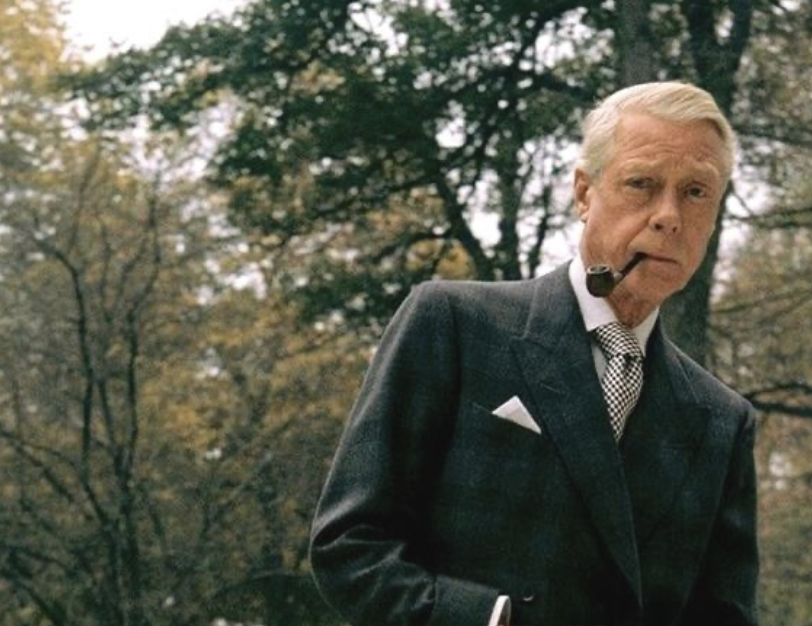
There are very few individuals whose personal wardrobe choices meaningfully shaped the way an entire century dressed. The Duke of Windsor is one of them. Born Edward, Prince of Wales, later briefly King Edward VIII, and eventually simply the Duke of Windsor after his abdication in 1936, he lived a life of near-constant public attention and used that attention, whether intentionally or not, to reshape men's tailoring in ways that persist to this day.
His name is attached to specific innovations that clients still consider when commissioning bespoke garments today. The Windsor knot. The Prince of Wales check. The soft-shouldered drape cut. The midnight blue tuxedo. Even the way modern men mix patterns, layer casual elements with formal ones, and wear brown shoes with suits traces back, at least in part, to the choices this one man made and popularized nearly a century ago.
This is a look at the Duke of Windsor, the specific style innovations associated with him, and what his approach can still teach clients building a considered wardrobe today.
A Brief Life
Edward was born in 1894, the eldest son of King George V. He was groomed from birth for the throne and spent his early adulthood as Prince of Wales, one of the most photographed men in the world. His father died in January 1936, and Edward became king. He held the throne for less than eleven months.
The reason for his short reign is one of the most famous scandals of the twentieth century. Edward wanted to marry Wallis Simpson, an American who had been divorced once and was in the process of a second divorce. The Church of England, of which the king was head, did not permit remarriage of divorced persons whose former spouses were still living. Given the choice between the crown and the woman he loved, Edward chose the woman. He abdicated in December 1936 and was given the title Duke of Windsor. He and Wallis married the following year and lived largely in exile until his death in 1972.
The politics and personal ethics of the abdication remain contested. His sartorial legacy, however, is unambiguous. Across his long life, and particularly across the decades after his abdication, the Duke of Windsor was widely regarded as one of the most stylish men in the world. His influence on how men dressed extended far beyond royalty or celebrity, reaching into the daily wardrobes of professionals throughout Europe and America.
The Man Who Helped Invent Modern Tailoring
The most important thing to understand about the Duke's influence is that he did not invent a single style so much as he broke down the rigid formality that had defined men's dress in the Victorian and Edwardian eras before him. His approach to tailoring was, for its time, radical in a specific way. He preferred comfort. He preferred soft shoulders over structured ones. He mixed patterns that were traditionally kept separate. He wore brown suede shoes with tailored clothing at a time when black leather was still expected. He wore tweeds in London in the middle of the week when they were still considered proper only for the country.
None of these choices was outrageous. That was part of what made them so influential. He did not dress eccentrically. He dressed thoughtfully, with a preference for personal comfort and a willingness to combine elements that convention had kept separate. Because he was one of the most-watched men in the world, his choices were noticed, copied, and eventually normalized.
By the middle of the twentieth century, much of what had been considered informal or unconventional in the 1920s had become mainstream. The Duke's fingerprints are all over that shift.
The Specific Innovations
Several specific style points are associated directly with the Duke of Windsor. Some he invented. Some he popularized. All of them carry his name or his influence in the tailoring world today.
The Windsor Knot and the Spread Collar
The Windsor knot, the thick, symmetrical tie knot that produces a wide triangular shape under the collar, is named for him. Here is a fact that surprises most people. The Duke did not actually wear a Windsor knot. He preferred the smaller, more elegant four-in-hand knot, which he tied with unusually thick ties made from thicker cloth than was standard at the time. The result was a knot that appeared larger than a four-in-hand knot on a standard tie, but was not actually the massive triangular knot that later took his name.
The Windsor knot as we know it today was a later innovation, developed by tie makers and enthusiasts to replicate the appearance of the Duke's thick-tie style using more standard cloth. The spread collar he preferred, wide enough to accommodate the appearance of a thicker knot, was similarly named the Windsor collar and remains one of the most versatile collar styles in modern shirting.
The Prince of Wales Check
The bold, large-scale glen plaid pattern known as the Prince of Wales check is often assumed to be named for the Duke of Windsor from his years as Prince of Wales. In fact, it was named for his grandfather, Edward VII, who wore it when he held the title. The Duke, however, is the man who popularized it in the twentieth century. He wore the pattern extensively in suits, sport coats, and outerwear, and his frequent public appearances in Prince of Wales check made it one of the signature patterns of twentieth-century tailoring.
Today, a Prince of Wales check suit is still a distinctive choice for clients who want a pattern that reads as considered and traditional without being conservative.
Brown Shoes with Everything
Before the Duke of Windsor, the rules for shoe color in tailored clothing were relatively strict. Black shoes were worn with business and formal attire. Brown shoes were reserved for country and casual wear. The Duke ignored this convention and wore brown suede and leather shoes with tailored clothing across a wide range of contexts, including with suits in London.
At the time, this was mildly scandalous. Today, it is entirely standard. A brown shoe with a navy suit, or a rich brown suede with a grey flannel, are choices that any well-dressed man makes without a second thought. That freedom traces directly back to the Duke.
Midnight Blue Instead of Black
For formal evening wear, the Duke preferred midnight blue over black. His observation was that under artificial light, midnight blue actually reads as darker and richer than true black, which can appear slightly grey or dusty under the same conditions. The result is that a midnight blue tuxedo, worn in an evening setting, looks more formal and more luminous than a black one.
This preference has become one of the classic pieces of tailoring wisdom, and midnight blue tuxedos remain a specific choice worth understanding for clients commissioning formal evening wear.
The Softer Silhouette
Perhaps the most consequential of the Duke's contributions was his preference for softer, less structured tailoring. His primary tailor for many years was Frederick Scholte, who developed what became known as the London Cut or drape cut. This style featured a softer shoulder, more fullness through the chest, and a slightly more comfortable overall silhouette than the tightly structured tailoring that had preceded it.
The drape cut proved enormously influential. It shaped the American Ivy League style that emerged in the 1930s and 40s. It was later adopted and refined by Anderson and Sheppard, one of Savile Row's most respected houses, and it became part of the broader language of English tailoring. The current moment in tailoring, which favors softer shoulders and more relaxed proportions, traces some of its lineage directly back to what Scholte developed for the Duke.
The Principles Behind the Innovations
Looking across the specific innovations, several principles emerge from the Duke's approach to dress. These principles are more useful than the individual style points themselves, because they explain why his choices worked and why they endured.
Comfort was a priority. He did not dress for photographs or for the approval of critics. He dressed to move through his days comfortably, and his tailoring reflected that. Softer shoulders. More generous cuts. Fabrics chosen for how they wore rather than for how they looked in a display case.
Combinations were allowed. He mixed patterns that convention had kept separate. He wore casual elements with formal ones. He treated the rules of dress as guidelines rather than commandments, and he trusted his own eye to make combinations work.
Small details mattered. He paid attention to the specific choices that made an outfit distinctive. The exact shade of blue in an evening jacket. The specific weight of a tie fabric. The precise cut of a collar. These small decisions accumulated into a wardrobe that read as unmistakably his own.
And personal character was allowed to show. The Duke's wardrobe was distinctive because he made choices that reflected his own taste rather than deferring entirely to convention. This is the deepest lesson from his example. Well-dressed men throughout history have almost always been men who made specific choices about how they wanted to appear, and who let those choices show.
What the Duke's Style Means Today
For clients building bespoke wardrobes in the current moment, the Duke of Windsor's example is still worth studying. Not because his exact wardrobe should be copied, but because his approach to dressing well is still fundamentally correct.
Choose comfort alongside refinement. A well-cut suit that fits properly and moves with you will always look better than a stiffer, sharper garment that resists your body. This is the drape cut principle in modern form.
Trust the small details. The color of the tie, the shape of the collar, the choice of button, the specific weight of the fabric all matter, and the accumulation of those small choices is what makes a wardrobe read as considered.
Let your personality show. The best-dressed clients we work with are not the ones who follow the rules most strictly. They are the ones who understand the rules well enough to make specific choices about which ones to keep and which ones to bend.
If you would like to talk through what a considered wardrobe might look like for you, drawing on the same principles that shaped the Duke of Windsor's approach to tailoring, we welcome the conversation. Appointments are available at our Shadyside showroom.
Samuel Baron Clothiers is a bespoke men's clothier located at 201 South Highland Avenue in Shadyside, Pittsburgh, PA. Appointments are required. Call (412) 441-1144 or visit samuelbaronclothiers.com to book.