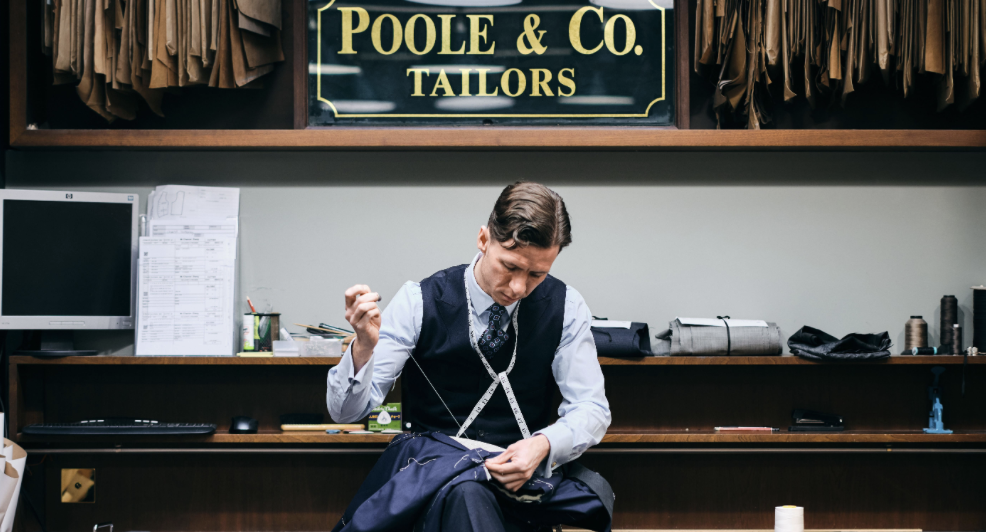
There is a moment in every bespoke commission that happens entirely outside the client's view. It takes place after the first appointment, before the fabric is cut, in a room where the client has never been. It is where measurements become a garment. This step is called pattern drafting, and it is the single most important part of the work.
Most clients never see it. Most clients never think to ask about it. But it is the step that defines what bespoke actually means, and it is the reason a bespoke garment fits and performs in ways that other alternatives cannot match. This is a guide to what happens with your measurements after they leave the showroom.
What a Pattern Actually Is
A pattern is a paper template. Physically speaking, it looks unremarkable: a series of large sheets of paper, marked with careful lines that represent every piece of a finished garment. The jacket front. The jacket back. The sleeves, each one drawn separately. The collar, the lapel, the pockets, the interior structural pieces. Every element of the finished garment corresponds to a piece of the pattern, and every piece of the pattern is cut individually from the fabric before the garment is assembled.
What makes a bespoke pattern different from any other kind of pattern is that yours does not exist yet when you walk in for your first appointment. It is drafted from scratch, using your measurements and your proportions, to be uniquely yours. There is no template to modify, no baseline size to adjust downward. The pattern begins as a blank sheet of paper, and every line drawn on it is drawn specifically for you.
The Bespoke Distinction
The terms bespoke and made-to-measure often get used interchangeably in casual conversation, but they refer to two fundamentally different processes. Understanding the difference is worth the time, because it changes the entire nature of the finished garment.
In a made-to-measure commission, the process begins with a standardized base pattern. The client's measurements are taken and used to modify that pattern, adjusting the length here, the width there, the sleeve length as needed. The result is closer to a proper fit than off-the-rack, but the pattern itself was never yours to begin with. It is someone else's pattern, modified to approximate your proportions.
In a bespoke commission, the process begins with nothing. There is no base pattern. Your measurements are used to draft a pattern from scratch, on paper, with a line drawn for every dimension of your body. The pattern accounts for your posture, your proportions, and the way you actually carry yourself. It is not an adjustment of someone else's template. It is a template built for you.
This distinction is easy to blur, which is why so many companies use these terms interchangeably. In practice, the difference shows up in every garment produced. A bespoke pattern will fit its owner in ways that a modified base pattern cannot, because it was designed around them from the beginning rather than adapted to them after the fact.
What Goes Into Drafting Your Pattern
At your first appointment, your clothier takes a comprehensive set of measurements. Chest, shoulder, sleeve, waist, hips, trouser rise, inseam, back length, and dozens of other dimensions that most clients have never had recorded before. But measurements alone are not enough to draft a pattern.
Alongside the numbers, your clothier records observations about your posture and your proportions. Do you carry your shoulders forward or back? Is one shoulder slightly higher than the other, as it is in most people? What is the balance between your front and back length? How does your weight settle when you stand at rest? These questions matter as much as any measurement, because a pattern that ignores them will produce a garment that fights against your body rather than moving with it.
Your clothier also asks about how you actually live in your clothing. Do you sit at a desk most of the day, or move constantly? Do you drive frequently? Do you keep items in your jacket pockets, and if so, which ones? Do you carry a phone on the right or left? Every one of these questions affects how the pattern is drafted, because a bespoke pattern is designed to serve a specific person's life, not just their body dimensions.
Back in the pattern room, all of this information is translated into paper. Each element of the garment is drawn individually, calibrated to your specific measurements and proportions. Lines are drawn, curves are measured, and the pattern comes together over the course of hours. It is unhurried work, done by hand, using the same tools and methods that bespoke tailors have used for generations.
The Pattern as a Permanent Record
Once your pattern is drafted, it is kept on file permanently. Every future garment we make for you begins from that same pattern, refined further with every commission based on what we learn about how the garments actually wear on you.
This is one of the quiet advantages of a long-term bespoke relationship that most clients only appreciate after a few commissions. Your first suit is drafted from a new pattern, and it fits well. Your second is drafted from that same pattern with minor refinements based on the first fitting, and it fits better. Your third and fourth reflect further refinement, and by that point the pattern is calibrated to you in a way no first commission ever could be. The garments improve with every piece, not because our work is improving in general, but because your specific pattern is being refined in specific ways.
The pattern also serves as insurance against the future. If your body changes over the years, as most bodies do, we can adjust your existing pattern rather than starting from scratch. If you decide to commission a garment in a style you have not tried before, your pattern gives us a foundation to build from. Twenty years from now, when you walk in for a new commission, your pattern will still be here, and everything we make for you will begin from the accumulated knowledge of every previous garment.
Why Pattern Drafting Cannot Be Automated
In an era where much of the garment industry has been optimized for speed and scale, pattern drafting has resisted automation more stubbornly than almost any other step. Computerized systems exist, but they produce results that experienced pattern makers can recognize immediately as computer generated. The lines are too clean, the proportions too idealized. The pattern lacks the small adjustments that a human eye makes intuitively when the client is standing in front of them.
At Samuel Baron Clothiers, every pattern is drafted by hand. The measurements are transferred to paper by a person who has been doing this work for years, who knows how bodies actually move, who accounts for the client's individual quirks the way only human judgment can. It is not the fastest way to work. It is not the cheapest way to work. But it is the only way to produce a pattern that reflects an individual client rather than a statistical approximation of one.
The Foundation of Everything That Follows
Every element of the finished garment traces back to the pattern. The way the jacket sits on your shoulders. The way the sleeve moves with your arm. The way the trouser breaks over your shoe. The comfort you feel wearing it, and the presence it gives you when you do. All of it flows from the pattern that was drafted specifically for you, and none of it can be replicated by shortcuts.
If you have not yet gone through the pattern drafting stage of a bespoke commission, this is what awaits after your first appointment. If you have, this is what has already been done for you, and what will inform every future garment we make. The pattern is where bespoke begins, and it is the reason every subsequent step of the process is possible.
If you would like to talk through a first commission or add to an existing bespoke wardrobe, we welcome the conversation. Appointments are available at our Shadyside showroom.
Samuel Baron Clothiers is a bespoke men's clothier located at 201 South Highland Avenue in Shadyside, Pittsburgh, PA. Appointments are required. Call (412) 441-1144 or visit samuelbaronclothiers.com to book.