There is a short street in central London that has shaped the way men dress across the entire world for over two hundred years. It runs for just under a quarter mile. Fewer than two dozen tailoring houses occupy its address at any given time. And yet almost every meaningful development in modern men's tailoring, from the structure of the business suit to the standards of bespoke construction, traces back in some way to the work done on this one street.
Savile Row is not a style. It is not a brand. It is a specific place, with a specific history, and a specific body of practice that defines what the word bespoke actually means in the modern tailoring world. For clients who commission bespoke garments today, including those who do so with us here in Pittsburgh, the Savile Row tradition is the backdrop against which the entire conversation takes place.
This is a look at where Savile Row came from, what it stands for, and why its tradition still matters nearly two centuries after it began.
The Street and Its Setting
Savile Row sits in Mayfair, in the center of London, between Regent Street and New Bond Street. It was laid out in the 1730s, part of the Burlington Estate, and was originally a residential street for the English aristocracy. By the late eighteenth century, military officers and well-off tradesmen had begun to settle in the area. By the early nineteenth century, the first tailors had moved in to serve them, and the character of the street was set.
Nearly two centuries later, the street still houses the heart of English bespoke tailoring. The names on the doors have shifted over the decades. Some houses have closed. Others have been founded. A few have survived unbroken for well over a century. But the trade itself, and the specific standards of work that define it, have remained remarkably consistent across all that change.
The Founding Generation
The earliest tailors in the area did not call themselves bespoke tailors in the way we understand the term today. They were simply tailors who happened to serve a clientele of exceptional wealth and taste. The modern Savile Row tradition really begins with a few specific figures whose influence shaped everything that followed.
Beau Brummell and the Case for Restraint
Before the tailors came the client. George Bryan Brummell, better known as Beau Brummell, was an English dandy and friend of the future King George IV. In the early years of the nineteenth century, he set the standard for how a well-dressed English gentleman should appear. His approach was revolutionary for its time. He rejected the brightly colored, ornately embroidered court dress that had defined English fashion in the eighteenth century and insisted instead on dark, perfectly cut clothing in restrained colors.
Brummell's influence was less about specific garments than about a philosophy. Dress with precision. Pay attention to fit above everything else. Choose quality cloth and classical colors over ornament. The tailors who dressed him, and later the men who followed his lead, had to meet an entirely new standard of workmanship to deliver what he demanded. This standard became the foundation of what Savile Row would eventually produce.
Henry Poole, the Founder of Savile Row
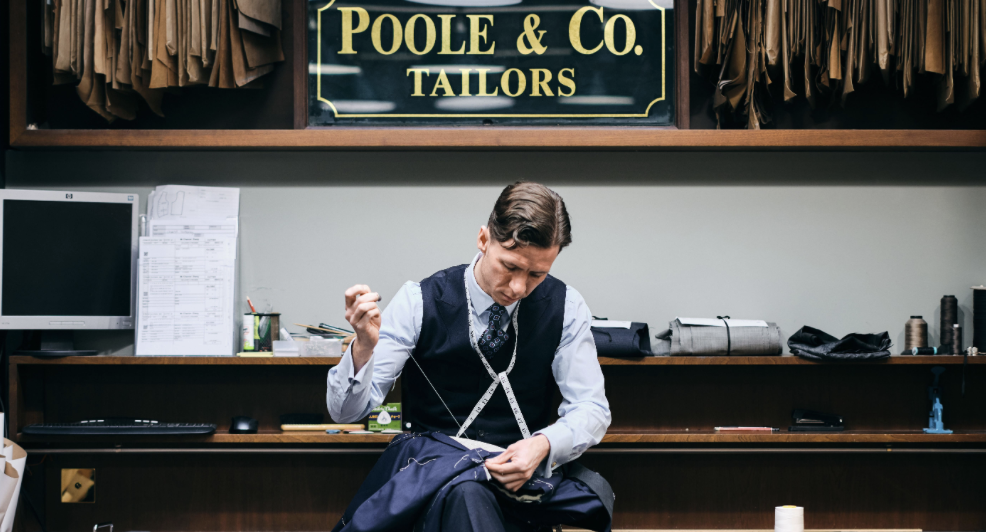
The specific tailoring house most often credited as the founder of modern Savile Row is Henry Poole and Co. Founded in 1806 by James Poole, the business was passed to his son Henry, who moved the firm to its current Savile Row address in 1846. Henry Poole was a shrewd and influential businessman who cultivated the finest clients in Europe. By the mid-nineteenth century, Poole counted Napoleon III, Edward VII, and much of the European nobility among his clients.
Poole's house also invented, or at least popularized, several specific garments that remain central to modern men's tailoring. The dinner jacket, now called the tuxedo in American usage, is widely credited to Poole, who created the garment for the future King Edward VII in 1865 as a less formal alternative to tailcoats for evening wear. The modern business suit, in forms recognizable today, also owes much to Poole's house and the standards it set.
The Houses That Followed
Through the second half of the nineteenth century and into the twentieth, dozens of tailoring houses opened on or near Savile Row. Some have faded. Many are still in business today. The names that remain active, each with its own particular house style and clientele, include Henry Poole, Gieves and Hawkes (which actually predates Poole, founded in 1771), Anderson and Sheppard, Huntsman, Dege and Skinner, Norton and Sons, Henry Herbert, Richard Anderson, and a number of younger houses that have joined the tradition more recently.
Each of these houses carries its own cutting style, its own preferences for construction, and its own particular clientele. A suit from Anderson and Sheppard, with its soft shoulder and generous drape, looks and feels different from a suit from Huntsman, with its sharper lines and more structured shoulder. These house styles are part of what makes Savile Row genuinely interesting. There is no single Savile Row look. There is a family of related approaches, all operating at the highest level of craftsmanship.
What Makes Savile Row Distinctive
The specific features that distinguish Savile Row bespoke work, and that define bespoke tailoring as a category, were refined on this street over nearly two centuries. Understanding these features is the key to understanding what the word bespoke actually means.
The Pattern Drafted From Scratch
At the heart of Savile Row bespoke is the principle that every garment begins with a pattern drafted individually for the client. There is no base pattern to adjust. There is no standardized size to modify. The pattern is drawn from measurements and observations taken at the first appointment, calibrated to the specific proportions and posture of the individual, and used as the foundation for every garment that will ever be made for that client. This is the point we have written about in our own pattern drafting piece. It is the technical fact that distinguishes bespoke from made-to-measure, and it was established on Savile Row.
The Handwork
A Savile Row bespoke garment is defined by the extent of its handwork. The canvas inside the jacket is pad-stitched by hand to the outer cloth. The buttonholes are stitched by hand. The lapel roll is shaped by hand. The lining is often set by hand. The small details, the ones a wearer only notices if they look very closely, are what separate a hand-made garment from a machine-assisted one.
This is not nostalgia. Hand-stitching produces specific effects that machine stitching cannot replicate. A hand-set sleeve has a slightly different shape than a machine-set one. A hand-pad-stitched canvas moves with the body in ways a fused or machine-stitched canvas cannot. The handwork is not decorative. It is structural, and it is what gives Savile Row bespoke garments their characteristic feel over years of wear.
The Apprenticeship System
The skills required to produce bespoke work at the Savile Row standard take years to acquire. The tradition for most of its history has been one of formal apprenticeships, with young tailors learning each specific operation under the supervision of experienced masters. A cutter, the person who drafts the pattern and oversees the garment's construction, might spend fifteen or twenty years before being considered fully qualified. A hand tailor, who performs specific operations like buttonholes or hand-set sleeves, develops a kind of mastery that only comes from decades of focused practice.
This apprenticeship system is one of the quieter but most essential features of the Savile Row tradition. The skills exist because they are passed on. Every generation of Savile Row tailors trains the next, and the standards persist because the people who hold them pass them down.
Multiple Fittings
A Savile Row bespoke commission typically involves multiple fittings, each at a specific stage of the garment's construction. The basted fitting, with the garment loosely assembled in muslin or basting thread, allows for major adjustments to proportions and shape. The forward fitting, further along in the process, allows for refinement. The final fitting checks everything one last time before the garment is delivered. This multiple-fitting process is standard on Savile Row and is one of the reasons the garments achieve the fit they do.
The Modern Challenges
The Savile Row tradition has survived the transition from the horse-drawn carriage to the automobile, through two world wars, through the collapse of English manufacturing in the twentieth century, and through the rise of ready-to-wear fashion that threatened to make bespoke tailoring obsolete. It has not survived without challenges.
The economics of bespoke are difficult. A single Savile Row suit can take between fifty and eighty hours of skilled labor to produce. The costs are correspondingly high. The clientele that can and will pay for this kind of work is relatively small. Across the twentieth century, several famous houses closed or merged under the pressure. The rents on Savile Row itself have risen dramatically, in some cases making it difficult for traditional houses to continue operating at the street's historic addresses.
The response from the surviving houses has been a mix of continuity and innovation. Younger tailors have joined established houses and brought new energy to the trade. Several houses have expanded their offerings to include ready-to-wear and made-to-measure lines, which help subsidize the pure bespoke work. The Savile Row Bespoke Association, formed in 2004, works to preserve the standards of the trade and to clarify what counts as genuine Savile Row bespoke in a market where the term is often used loosely.
Through all of this, the core practice has continued. Bespoke garments are still cut and made on Savile Row today using the same methods and standards that defined the trade a century ago. The tradition is not frozen. It evolves. But its essential character has remained.
Why Savile Row Still Matters
For clients commissioning bespoke garments in Pittsburgh, or anywhere outside London, Savile Row might seem distant. The practical answer is that it is not. The standards that were developed on Savile Row are the standards that define bespoke tailoring everywhere. The methods used in the finest tailoring houses in Naples, Milan, New York, and here in our own showroom all trace their lineage, in one way or another, to the practices established on this one London street.
When a bespoke commission is done properly today, the pattern is drafted from scratch. The handwork is extensive. The fittings are multiple. The attention to the individual client's proportions and preferences is specific. These are the standards that Savile Row made the global baseline for what bespoke tailoring is supposed to be.
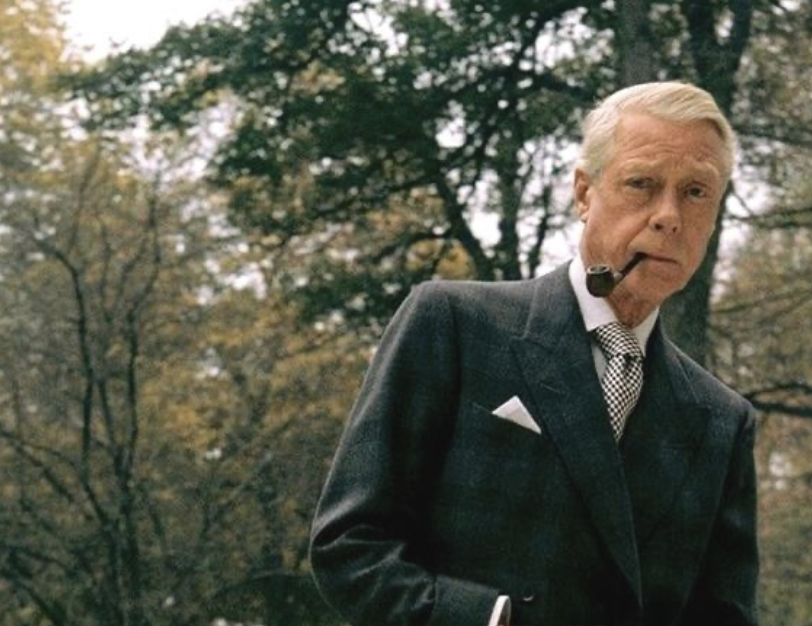
For clients who understand the tradition, there is a particular pleasure in knowing that the garment on your body belongs to a lineage of work that goes back over two centuries. Your suit is not simply a new object. It is part of a tradition that connects back through the clients who wore Henry Poole in the nineteenth century, through the Duke of Windsor and the generations of statesmen and professionals who shaped how modern men dress, all the way to Beau Brummell and the moment when the modern wardrobe was first being imagined.
The Tradition in Practice
At Samuel Baron Clothiers, our approach to bespoke work is informed by this tradition. The pattern is drafted individually for each client. The handwork is extensive. The attention to the small details, the ones that separate a bespoke garment from a merely well-made one, is specific. We do not operate on Savile Row. But the standards that define the trade are the standards we hold ourselves to.
If you would like to talk through what a bespoke commission in that tradition might look like for you, we welcome the conversation. Appointments are available at our Shadyside showroom.
Samuel Baron Clothiers is a bespoke men's clothier located at 201 South Highland Avenue in Shadyside, Pittsburgh, PA. Appointments are required. Call (412) 441-1144 or visit samuelbaronclothiers.com to book.