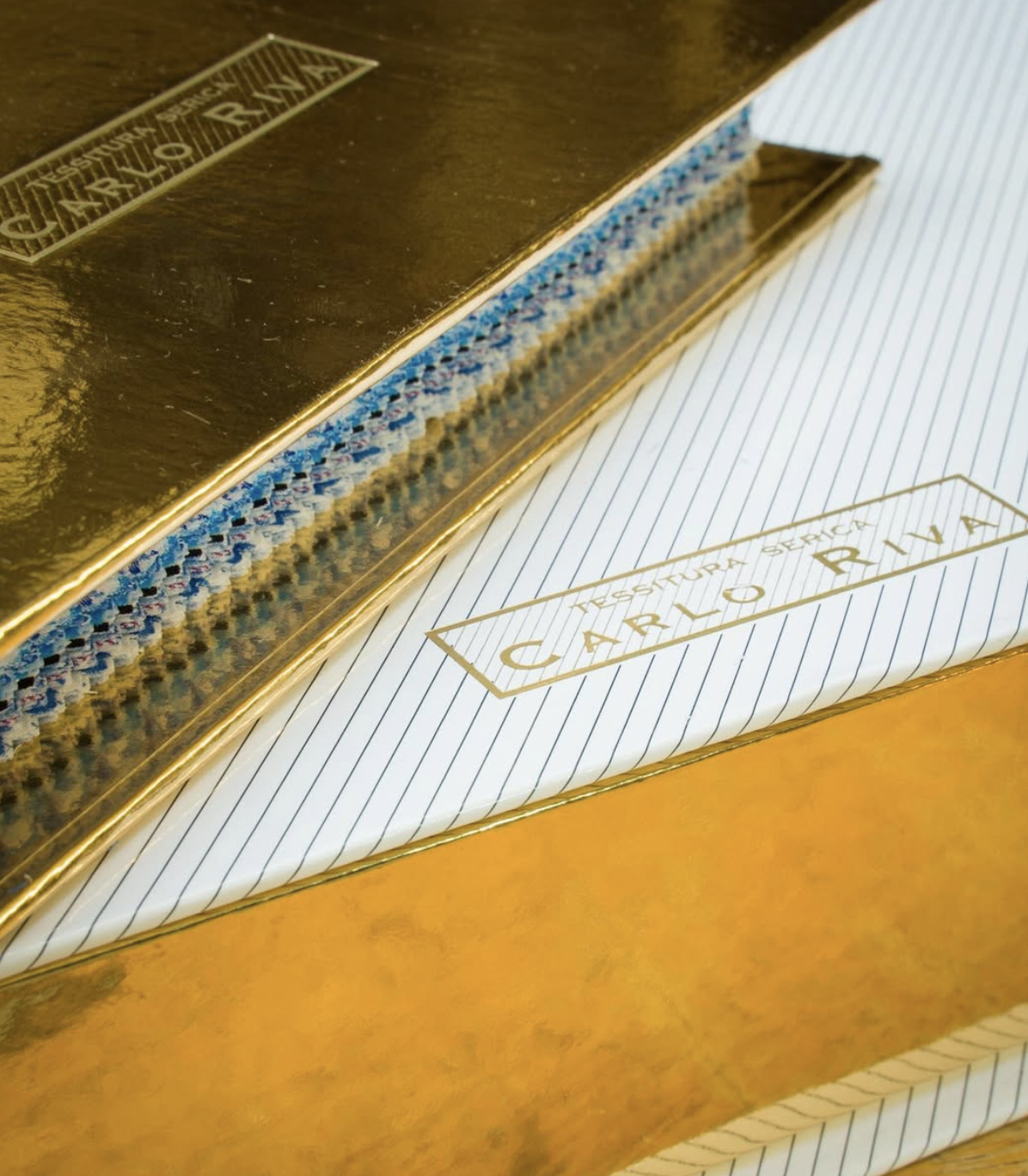
Some fabrics earn their reputation over decades. Others earn it by producing genuinely unmatched work. And a very small number, over generations, become the shorthand for their entire category. In the world of fine shirting fabric, Carlo Riva belongs firmly in that last group. Among people who care about these things, the name carries a specific meaning: the finest shirting cloth produced anywhere in the world.
For clients who have not come across it before, this is worth knowing about. Carlo Riva is one of the shirting fabrics we love working with, and the story behind it is one of the most interesting in the entire textile world. It involves a family with roots going back to 1871, a discovery of forgotten antique looms in the Italian hills, and a philosophy of production that stubbornly refuses to compromise for the sake of efficiency.
This is a look at Carlo Riva, and at why the shirts made from their fabric feel unmistakably different from any other.
A Story That Begins with Silk
The Carlo Riva story does not start with cotton. It starts, more than 150 years ago, with silk.
The parent company, Fermo Fossati, was founded in 1871 near Lake Como. At the time, the region was one of the great centers of European silk production, and Fermo Fossati established itself as one of the finest silk weavers in Italy. For nearly a century, the company focused on silk, developing deep expertise with the shuttle looms that were standard across the industry at the time.
By the mid-twentieth century, however, the silk market had begun to shift. Global demand was declining, and the postwar era saw a growing focus on cotton for fine shirting. In the 1960s, the company made a decision that would define its future. Rather than abandon its expertise in shuttle-loom weaving, it would apply that expertise to a new material. The silk looms were adapted to produce cotton shirting, and the Carlo Riva division was born.
This is more meaningful than it might sound. The vast majority of shirting fabric today is produced on modern high-speed looms that weave wide, fast, and uniformly. Carlo Riva chose the opposite path: slower, narrower, more attentive weaving, on looms that were already considered old-fashioned when the operation began.
The Discovery of the Antique Looms
The modern Carlo Riva operation owes much of its character to a specific decision made by Otto Mantero, who took over the direction of the mill and shaped its current identity.
Mantero had heard, as a young man, stories about cotton so fine that it was described as being lighter than a feather and smoother than silk. Years later, exploring the hills of northern Italy, he discovered a disused factory filled with antique shuttle looms. Some of them dated back to the very beginning of the twentieth century, well over 100 years old. Instead of replacing them with modern equipment, Mantero recognized what he had. The antique looms, weaving slowly and narrowly, could produce cloth that no modern loom could match.
Those looms, restored and put back into operation, are still at the heart of what Carlo Riva does today. The fabric coming off these looms in the twenty-first century is being produced on machinery that was already producing fine cloth when the Model T was new. It is a genuine link to the earliest era of industrial textile production, kept alive by a mill that has decided the old methods produce something the new ones cannot.
What Makes Carlo Riva Fabric Different
Three specific choices define Carlo Riva production and set it apart from other shirting mills.
The Vintage Looms
The looms themselves are the first and most important factor. Modern shirting looms weave at high speed and produce fabric in 150 centimeter widths, which is the industry standard for economical production. Carlo Riva looms weave much more slowly and in much narrower widths, generally 75 or 90 centimeters.
The narrower width matters because it reduces the tension on the yarn during weaving. A yarn under less tension can move and settle differently in the final cloth, producing a fabric that feels softer and drapes more naturally. The slower speed matters because it gives each row of thread more time to seat properly, further contributing to the fabric's distinctive hand.
The result is a shirting cloth that feels closer to silk than to conventional cotton. Clients who have handled Carlo Riva fabric alongside more standard shirtings often describe the difference as immediately obvious. There is a smoothness and a lightness to Carlo Riva cloth that comes directly from the way it is woven.
The Giza Cotton
The raw material also sets Carlo Riva apart. The mill uses Giza cotton, an ultra-fine Egyptian cotton grown in the Nile region, and specifically Giza 45, one of the rarest and highest quality varieties available anywhere in the world.
Giza cotton is prized for the length and fineness of its fibers, which produce a smoother, stronger, and more lustrous yarn than shorter-fiber cottons. The specific varieties Carlo Riva uses are among the most expensive raw materials in the shirting world, produced in limited quantities and reserved for the highest-end mills.
Before the cotton reaches Carlo Riva, it is twisted into yarn in Switzerland, another step in a production chain designed to preserve the fiber's quality at every stage. Only then is the yarn brought to Carlo Riva for weaving on the antique looms.
The Rest Period
The third distinctive step happens after the fabric is woven. Instead of being immediately packaged and sold, Carlo Riva fabric is rested for approximately one year in facilities kept at constant temperature and humidity. The conditions are calibrated to replicate the microclimate of the Nile region where the cotton was grown.
This rest period allows the fabric to fully stabilize and reach its final character. Cloth that has rested this long behaves differently in a finished shirt than cloth that has been sold immediately after weaving. It handles better under the iron, holds its shape better across many washings, and continues to soften rather than becoming rougher over years of wear.
Why It Matters for Your Custom Shirts
All of this care in the production of the fabric translates directly into the shirt on your body. Carlo Riva shirts have a specific quality that clients describe consistently: a softness and smoothness against the skin that no ordinary cotton shirting can match, combined with a subtle luminosity and drape that give the finished shirt a distinctive presence.
The trade-off is availability and cost. Carlo Riva fabric is produced in very small quantities. It is more expensive than conventional shirtings, sometimes considerably so. And for clients who care about these things, it is worth every bit of the difference.
We offer Carlo Riva as one of our shirting fabric options at Samuel Baron, alongside the other exceptional mills we work with. For clients whose custom shirts are among the most-worn parts of their bespoke wardrobe, Carlo Riva is a fabric worth knowing about and worth choosing when the occasion warrants.
Coming In to See It
Fabric like this is best understood by touching it. Reading about the difference between Carlo Riva and a conventional shirting is one thing. Feeling the two side by side, seeing how they catch light differently, holding them against a well-made shirt: this is where the character of Carlo Riva becomes immediately clear.
If you are considering a special custom shirt commission, or simply want to experience one of the most legendary fabrics in the shirting world, we welcome the visit. Carlo Riva fabric is available in the showroom, and we are always glad to walk clients through the differences that make the mill's work distinctive. Appointments are available at our Shadyside showroom.
Samuel Baron Clothiers is a bespoke men's clothier located at 201 South Highland Avenue in Shadyside, Pittsburgh, PA. Appointments are required. Call (412) 441-1144 or visit samuelbaronclothiers.com to book.