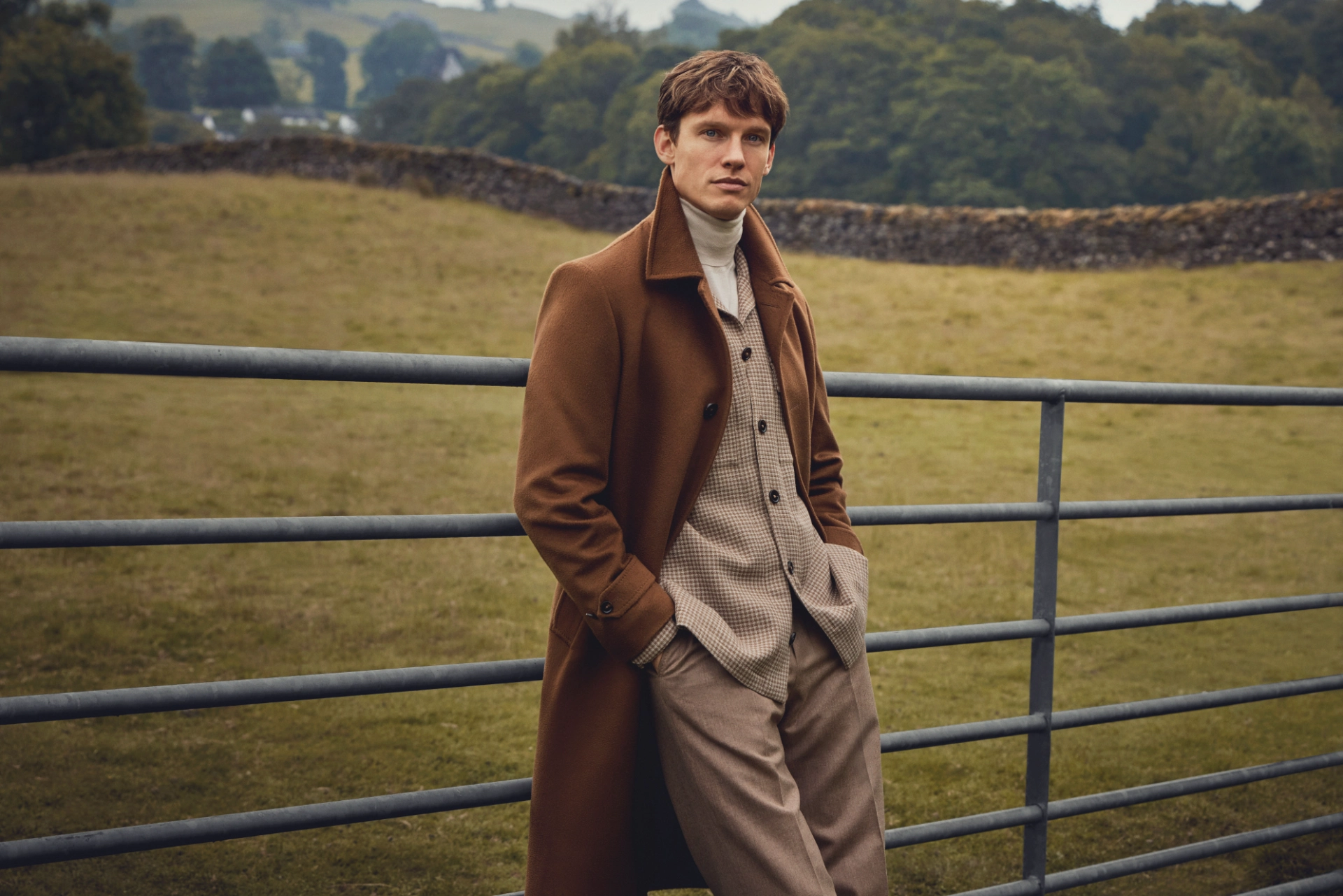
For most of the year, a tailored outfit ends at the jacket. From roughly November through March in Pittsburgh, it does not. The coat you put on over your suit becomes the first thing anyone sees when you arrive at a meeting, a dinner, or an event, and the last thing anyone sees when you leave. It is the frame around the entire outfit, and if it is wrong, nothing underneath can compensate.
Despite this, outerwear is often the least-considered part of a tailored wardrobe. Clients who commission bespoke suits with precision will frequently pair those suits with whatever coat they happened to already own. The result is a well-cut suit worn under a coat that undermines it, which is a particular kind of waste.
This guide covers the classic coat styles worth knowing, what distinguishes an overcoat from a topcoat from a trench coat, and how to think about building the right outerwear to pair with the suits already in your wardrobe.
Overcoat, Topcoat, Trench: What's the Difference
The three terms get used interchangeably, often incorrectly. They refer to distinct categories of garment, and understanding the differences is the right starting point.
The Overcoat
An overcoat is a heavy, warm, generally long outer garment designed for serious cold-weather wear. The fabrics are substantial, typically fourteen ounces or heavier, often in wool, cashmere, wool-cashmere blends, or camel hair. The length traditionally reaches the knee or below. The construction includes enough warmth to serve as the primary winter garment, worn over a suit, through genuinely cold weather.
The overcoat is what you want for December through February in a climate like Pittsburgh's. It is a true cold-weather garment, cut and built to serve as serious insulation while still finishing the outfit beneath it.
The Topcoat
A topcoat is a lighter-weight relative of the overcoat. The fabrics typically run eight to twelve ounces. The length is often slightly shorter. The construction is less heavily insulated. The topcoat is designed for the transitional seasons, for fall and spring, when a coat is required but a full overcoat would be excessive.
For Pittsburgh clients, a topcoat is particularly useful for October, November, March, and April. It completes the outfit, provides reasonable warmth, and travels much better than a full overcoat.
The Trench Coat
A trench coat is a specific garment with a specific origin. Developed during the First World War for British officers in the trenches, it was designed to repel rain while providing some warmth. The classic trench is made from cotton gabardine, treated for water resistance, and features a double-breasted front, a belt, shoulder epaulets, a storm flap on the right chest, and D-rings for equipment that have long since lost their original function but remain as design features.
A trench coat is primarily a rain coat. It provides minimal insulation. It is appropriate across a wide range of temperatures but is specifically useful when the weather is wet rather than cold. For spring showers and autumn rain, a trench coat is excellent. For a serious winter, it is not enough on its own.
The Classic Overcoat Silhouettes
Within the broader category of overcoats, several classical silhouettes have endured because they do specific things well. Knowing them helps make the right choice for your own wardrobe.
The Chesterfield
The Chesterfield is the most formal of the classic overcoats. It is cut long, straight, and clean, with a single-breasted front, notch lapels, and often a velvet collar in the traditional version. The silhouette is restrained and city-appropriate, with little decoration beyond the quality of the cloth and the precision of the cut.
A Chesterfield in dark navy, charcoal, or black is the right coat to wear over a business suit for serious professional occasions, formal evening events, and winter weddings. It is the coat that pairs correctly with a dark suit or a tuxedo without any compromise on formality.
The Polo Coat
The polo coat is an American classic with English roots. Originally worn by polo players between matches in the early twentieth century, it was adopted into mainstream American tailoring in the 1920s and 30s and became one of the signature coats of Ivy League and American business dressing. The classic polo coat is double-breasted, often in camel hair, with notch or peak lapels, patch pockets, and a half belt at the back.
The polo coat is less severe than a Chesterfield and reads as slightly more relaxed, but it still works beautifully over a business suit. A camel polo coat worn over a navy suit is one of the great classical combinations in menswear, and it carries a specifically American sensibility that stands apart from the more formal European traditions.
The Covert Coat
The covert coat originated as English country wear in the late nineteenth century, designed for riders in the dense, thorny undergrowth known as covert. The classic coat is cut shorter than a traditional overcoat, usually finishing just above or at the knee, made from a tight, durable covert cloth in a distinctive fawn or green color. The hallmark details include four rows of stitching on the cuffs and hem, a short center vent, and a single back button.
Over the twentieth century, the covert coat migrated from the countryside into city dress. The Duke of Windsor was an enthusiastic wearer. Today it works beautifully as a slightly less formal overcoat for business and professional occasions, pairing particularly well with suits in grey, brown, and tweed.
The Guards Coat
The Guards coat is the dress coat of British military officers, adopted into civilian wear across the twentieth century. It is cut long and clean, often double-breasted with six buttons, with a sharp waist suppression that distinguishes it from the straighter Chesterfield. The silhouette is formal, structured, and distinctly British.
A Guards coat works for the same contexts as a Chesterfield but reads as slightly more structured and dramatic. For clients who want a serious formal overcoat with more visual presence, a Guards coat is worth considering.
The Balmacaan
The Balmacaan is a raglan-sleeve overcoat with origins in Scotland. The distinguishing feature is the sleeve construction, where the sleeve seam runs diagonally from the collar to the underarm rather than being set at the shoulder. The result is a slightly softer, less structured silhouette through the shoulder and chest.
A Balmacaan reads as more relaxed than a Chesterfield or Guards coat and works well for business casual occasions, travel, and the kind of professional contexts where the full formality of a set-sleeve overcoat would be excessive. In a mid-weight wool, it is one of the most versatile coats a client can own.
How to Pair with Suits
The relationship between the coat and the suit it covers is where the choices start to matter in practical terms. A few guiding principles help organize the decisions.
Formality Should Match
A formal business suit calls for a formal overcoat. A Chesterfield in dark navy or charcoal, a Guards coat, or a well-cut polo coat all work. A tweed sport coat and odd trousers, by contrast, do not call for a formal city overcoat. A covert coat, a Balmacaan, or a Harris Tweed overcoat would be more appropriate. The coat and the suit should read as being from the same tradition of dressing.
Length Should Cover the Jacket
The overcoat should fully cover the suit jacket beneath it. A coat that stops above the jacket hem creates an awkward visible line that announces that the coat is too short. The traditional rule is that an overcoat should finish at or just below the knee. A topcoat can be slightly shorter but should still cover the suit jacket cleanly.
Color Should Harmonize
The color of the coat should relate to the suits it will cover. For a wardrobe of navy and charcoal suits, a dark navy, charcoal, or black Chesterfield is the correct starting point. For a wardrobe that includes brown suits, tweeds, or more varied colors, a brown or camel coat gains additional usefulness. A covert coat in its traditional fawn works across virtually all suit colors and is one of the most versatile choices available.
One Coat Cannot Do Everything
Clients who want serious outerwear in their wardrobes rarely stop at one coat. A dark Chesterfield or Guards coat for formal business and evening occasions. A topcoat or Balmacaan for transitional weather and more relaxed professional contexts. A trench coat for rain. A polo coat or covert coat for the specific aesthetic each one carries. These are different garments for different situations, and clients who commission more than one find that their outerwear meaningfully improves.
The Fabric Question
The cloth is where the overcoat's character is set, and the choices here are among the most enjoyable in all of bespoke commissioning.
For a serious winter overcoat, a dense wool or wool-cashmere blend in the fourteen to twenty ounce range provides the structure, warmth, and drape that make the garment work. Piacenza, Loro Piana, and other Italian mills produce exceptional overcoat cloths in these weights, often with a slight brushed finish that gives the surface the particular richness that defines fine overcoats.
For a camel polo coat, the traditional cloth is camel hair itself, which gives the coat its characteristic warm color, soft hand, and particular drape. Pure camel is specific and worth seeking out when the budget allows.
For a covert coat, the traditional covert cloth is a tightly woven worsted wool with a slight salt-and-pepper character, designed for durability. The cloth itself is part of what defines the garment.
For a Chesterfield or Guards coat, a fine melton or heavier worsted in deep navy, charcoal, or true black delivers the serious formal appearance these coats are built for.
For a topcoat, a lighter wool, wool-cashmere blend, or specialty cloth in the eight to twelve ounce range provides warmth without the full winter weight.
Why Bespoke Makes a Real Difference Here
Overcoats are one of the garments where the gap between off-the-rack and bespoke is particularly visible. An off-the-rack overcoat fits approximately, with shoulders that rarely sit correctly over a suit jacket, sleeves that are usually wrong, and a cut that does not account for the fact that the coat will be worn over tailored clothing underneath. The result is a coat that reads as approximate, no matter how good the fabric.
A bespoke overcoat is cut specifically to be worn over your suits. The shoulder is drafted to accommodate the suit jacket beneath. The chest and body are proportioned to fit cleanly without excess bulk. The sleeve length is correct relative to the suit sleeve and shirt cuff beneath. The result is a coat that finishes the outfit rather than compromising it.
For a garment that will be worn for many years, in the most visible moments of a professional and social life, this difference matters.
Timing
Winter outerwear is the commission that most consistently gets started too late. Clients remember in late November that their current coat is not working anymore, and by that point the production window has already closed on getting something ready for the heart of the season. A bespoke overcoat takes the same six to eight weeks as any other bespoke commission. For a coat that will be worn through December, January, and February, the conversation needs to start by mid-October at the latest.
For clients considering an overcoat commission for the current winter, this is the moment. For clients planning for next winter, late winter and early spring are the ideal windows.
If you would like to talk through what a proper overcoat might look like for your wardrobe, we welcome the conversation. Appointments are available at our Shadyside showroom.
Samuel Baron Clothiers is a bespoke men's clothier located at 201 South Highland Avenue in Shadyside, Pittsburgh, PA. Appointments are required. Call (412) 441-1144 or visit samuelbaronclothiers.com to book.